



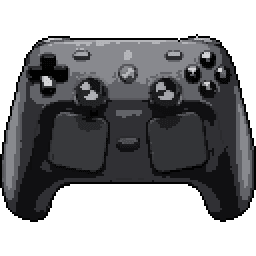
Steam Controller 2.0


Steam Controller 2.0 Input lag comparison
| # | Connection | Mode | LatencyAverage (ms) | Polling RateMedian (Hz) | Jitter | OSBuild ver. | FWTester ver. | |
|---|---|---|---|---|---|---|---|---|
| Latency P82 | ||||||||
1 | Cable | XInput | 6.60 4.07 | 256 | 1.95 1.32 | Win 10 10.0.19045 | --- 5.2.4.6 | |
Stick LatencyP82 1.51 ms 4.07 ms 6.81 ms 1.32 ms 253 Hz | ||||||||
2 | Cable PRIMARY | Steam | 4.12 5.08 | 241.49 | 1.11 3.10 | Win 11 10.0.26200 | --- 5.3.0.1 | |
Stick LatencyP82 ✓ Selected 1.11 ms 5.08 ms 9.32 ms 3.1 ms 241.49 Hz (see 📊) Polling Rate 3.6 ms 4.14 ms 5.39 ms 0.31 ms 241.49 Hz 248.95 Hz Note: This test are based on polling rate and do not represent actual input-lag. | ||||||||
3 | Dongle PRIMARY | Steam | 6.25 7.75 | 258.46 | 1.15 3.19 | Win 11 10.0.26200 | --- 5.3.0.1 | |
Stick LatencyP82 ✓ Selected 3.94 ms 7.75 ms 14.9 ms 3.19 ms 258.46 Hz (see 📊) Polling Rate 1.61 ms 3.87 ms 4.76 ms 0.69 ms 258.46 Hz 269.14 Hz Note: This test are based on polling rate and do not represent actual input-lag. | ||||||||
4 | Dongle | XInput | 9.14 7.35 | 271 | 1.77 1.33 | Win 10 10.0.19045 | --- 5.2.4.6 | |
Stick LatencyP82 4.53 ms 7.35 ms 10.12 ms 1.33 ms 272 Hz | ||||||||
5 | Bluetooth | XInput | 9.76 8.04 | 129 | 2.37 2.14 | Win 10 10.0.19045 | --- 5.2.4.6 | |
Stick LatencyP82 3.87 ms 8.04 ms 13.66 ms 2.14 ms 131 Hz | ||||||||
6 | Bluetooth PRIMARY | Steam | 7.26 10.2 | 134.23 | 2.07 4.31 | Win 11 10.0.26200 | --- 5.3.0.1 | |
Stick LatencyP82 ✓ Selected 3.17 ms 10.21 ms 16.09 ms 4.31 ms 134.23 Hz (see 📊) Polling Rate 6.87 ms 7.45 ms 9.11 ms 0.27 ms 134.23 Hz 133.42 Hz Note: This test are based on polling rate and do not represent actual input-lag. |
Latency
Our visualization focuses on Average Latency, presented as vertical bars to make comparing performance across different connection modes (Wired, Bluetooth, Dongle) instant and intuitive.
The chart differentiates between:
- Button Latency: How quickly the game registers a physical button press.
- Stick Latency: The delay in registering joystick movement (tested at 99% deflection).
Visualizing Stability (Jitter)
You may notice that the top portion of some bars is semi-transparent or "faded". This represents Jitter (instability):
- Solid Bar: Represents the stable, consistent average latency.
- Faded Top: Indicates the variance. A larger transparent area means higher jitter, implying the controller's response time fluctuates. A solid bar with little to no fading indicates a highly stable connection.
Deep Dive: Click the arrow to reveal Probability Distribution Charts. These show the exact breakdown of every input tested, displaying Probability (%) on the Y-axis and Latency (ms) on the X-axis.
Polling Rate vs. Latency
It is crucial to understand that Polling Rate and Latency are measured using two entirely different methodologies on our site:
- Latency (ms) is measured by the Prometheus 82 hardware. It captures the physical movement of the stick or button via hardware interrupts with microsecond precision. This is the "real-world" delay.
- Polling Rate (Hz) is measured via a Software Tool. It shows how often the OS receives reports from the USB stack.
Common Myth: A higher polling rate (like 8000 Hz) does not automatically guarantee lower latency if the controller's internal processing is slow. Conversely, a high polling rate on a chart might show fluctuations (e.g., 7800Hz instead of 8000Hz) due to OS jitter or CPU scheduling, which does not necessarily impact the hardware latency measured by the P82.
To test your own gamepad's polling rate, you can use our tool: Download Polling Rate Tester.
Testing Methods
Gamepadla ensures data integrity by combining three distinct testing methodologies:
-
Prometheus 82 (P82): Our gold standard. A custom-built hardware device that physically actuates buttons and sticks. It uses high-speed hardware interrupts to capture events, making it independent of the controller's polling rate. It provides an error margin of only ±1ms for buttons and sticks. View on GitHub.
-
GPDL Tester: An electrical monitoring tool for highly accurate button latency. While P82 simulates human-like mechanical movement, GPDL focuses on the electrical signal speed. View on GitHub.
-
Software Polling Test: A pure software diagnostic to check communication frequency. We use this to verify if a controller actually reaches its advertised specs (e.g., 1000Hz or 8000Hz) at the OS level. Download Software.
Note: By comparing hardware-level latency (P82) with software-level reports (Polling Test), we can identify if a controller has "fake" high polling rates or poorly optimized firmware.
Stick test of Steam Controller 2.0
Stick test results for Steam Controller 2.0 gamepad, by John Punch
Comment: Steam Raw Input
Errors Panel
Inner Deadzone
The Inner Deadzone is the area around the center of the stick where small movements are not registered. This helps prevent stick drift or accidental inputs, but if the deadzone is too large, it can make aiming less precise, especially in games requiring fine control. We evaluate the Inner Deadzone based on how much you need to move the stick before it responds - the less movement required, the better.
The Steam Controller 2.0 has no Inner Deadzone. The stick responds immediately to even the slightest movement, which is excellent for aiming accuracy and micro-control. This makes it a great choice for precision-heavy games like first-person shooters (e.g., Valorant or Apex Legends).
For comparison, many budget gamepads often have a moderate to large Inner Deadzone, while premium controllers typically aim for a slight or no deadzone for better precision.
Want to learn more? Check out our video explanation of how the Inner Deadzone works.
Outer Deadzone
The Outer Deadzone is the area near the edge of the stick's physical range where you are still deflecting it, but the system already registers the maximum 100% input. As a result, maximum speed (e.g., camera turn) is reached before the stick hits the physical gate. This narrows the effective range for precise aiming and can make edge control feel too sharp or twitchy. The smaller this zone, the better, as it allows you to use the entire physical range of the stick for precise control.
The Steam Controller 2.0 has no Outer Deadzone (< 0.4 mm). Any 'lost' range at the edges is within the margin of error, allowing you to use the full physical range of the stick. This is an ideal result for precise and predictable gameplay.
Per-stick breakdown for the Steam Controller 2.0: the left stick measures < 0.4 mm, which corresponds to no Outer Deadzone, while the right stick measures < 0.4 mm, which corresponds to no Outer Deadzone. This helps show whether the controller loses range evenly on both sticks or if one stick is noticeably weaker near full tilt.
Both sticks show the same measured Outer Deadzone, which suggests consistent edge behavior between movement and camera inputs.
For comparison, budget gamepads often have moderate to large Outer Deadzones, while premium controllers strive for minimal or no deadzone to maximize control.
Want to learn more? Check out our video explanation of how the Outer Deadzone works.
Stick Eccentricity & Asymmetry
Stick Eccentricity measures how close the outer stick boundary at 100% deflection is to a perfect circle. An uneven deflection in specific directions makes edge-aiming unpredictable. The more circular the boundary (lower eccentricity), the more predictable and consistent the stick movements in all directions. Lower is better.
For the Steam Controller 2.0, the Eccentricity is 5.1% (left) and 2.4% (right).
Stick Asymmetry is an additional test of the stick's movement path at partial deflection (~80%) using physical limiters (brackets). This reveals asymmetries that might be hidden by clamping at 100% deflection. The more uniform the movement (lower asymmetry), the more predictable the actions in games.
For the Steam Controller 2.0, the Asymmetry is 15.7% (left) and 3.5% (right).
Testing Methodology: It's crucial to note that the asymmetry test is performed at partial stick deflection (~80%), using special physical limiters (brackets/clips). Testing at 100% deflection often hides asymmetries because the controller's output is clamped at the maximum value, artificially 'smoothing' the resulting shape. Our method reveals the true performance of the stick in the ranges most critical for gameplay. This precise approach was also utilized by Linus Tech Tips in their controller review.
For comparison, many budget gamepads show asymmetry levels above 30%, while high-end controllers typically stay below 10% for better uniformity.
Learn more about how different gamepads perform in the Stick Asymmetry test and how to conduct such a test in this article. You can learn how to test joystick asymmetry yourself from this video.
Circle Error
Circle Error evaluates how closely the stick’s movement follows a perfect circle. A high Circle Error means the path is more square-like, which can cause inconsistent speeds when moving diagonally - your character might move faster or slower than expected. The lower the percentage, the better, as it ensures smooth, uniform movement in all directions.
For the Steam Controller 2.0, the Circle Error is 8.2% for the left stick and 9.1% for the right stick. This is a moderate result. Diagonal movement is mostly smooth, but minor speed variations or minor square-like behavior might be felt in some situations.
For comparison, budget gamepads often have Circle Errors above 12%, resulting in 'square' feeling sticks, while high-quality ones aim for under 8% for better smoothness.
Want to learn more? Check out our video explanation of how Circle Error impacts performance.
Resolution (Stick Bitness)
Stick Bitness measures the precision of the joystick’s analog input, similar to bit depth in audio. Higher bitness means more distinct positions the stick can register, leading to smoother and more accurate control. Lower bitness can result in 'stepping' or less fluid movement, especially noticeable in slow, precise actions like aiming.
Unlike declared digital resolution, our True Bitness metric is derived from actual physical stick movement, reflecting the usable positions the stick can produce in practice.
For the Steam Controller 2.0, the movement-based True Bitness is 11.4 bits on both sticks. This is moderate precision. It is generally adequate for most games, though some stepping might be noticeable in high-precision aiming.
This corresponds to a measured Step Resolution of 0.00074 on the left stick and 0.00074 on the right. In practical terms, this means the gamepad can register about 1,351 individual steps from the center to the edge (SFC) on the left stick, and 1,351 SFC on the right.
For comparison, many budget gamepads have around 8 bits, while premium ones often exceed 10 bits for superior accuracy.
Want to learn more? Check out our video explanation of how Stick Bitness affects control. It is important to note that the video specifies the resolution of the stick, not the bit depth; the higher the bit depth, the higher the resolution.
Center Error (Stick Centering)
Center Error (also referred to as Stick Centering) measures how accurately the joystick returns to its neutral (center) position after you release it. A low Center Error prevents stick drift - a common issue where your character or camera moves slightly in a game, even when you're not touching the stick. The lower the percentage, the better the centering, and the less likely you are to experience drift.
For the Steam Controller 2.0, the Center Error is 3.7% for the left joystick and 3.4% for the right stick. This is a moderate result. Because this controller has no built-in inner deadzone to hide mechanical imperfections, its natural center error is exposed. You will likely need to configure a small deadzone within game settings (like in Apex Legends) to counteract potential drift.
This test methodology intentionally employs a more rigorous approach by implementing small-angle deflection and release, which produces the most challenging conditions for stick re-centering. This technique differs from the conventional maximum-deflection method where the stick is pulled to its full range and released, as small-angle deflection better simulates the micro-adjustments typically executed during actual gameplay scenarios, providing more representative data on potential stick drift occurrence during normal use.
Want to learn more? Check out our video explanation of how Center Error works.
Cardinal Snapping
Cardinal Snapping (sometimes referred to as Axis Magnet) is a form of stick processing where the controller's output artificially 'snaps' or clings to the cardinal (horizontal and vertical) axes when the stick passes close to them. While this can make pure horizontal or vertical movements feel perfectly straight, it distorts the natural movement path and makes diagonal aiming or fine steering less predictable.
The Steam Controller 2.0 shows no Cardinal Snapping. This means the stick does not artificially cling to the horizontal or vertical axes, preserving your real movement path for consistent aiming and natural analog control.
Want to learn more? Check out our video explanation of how Cardinal Snapping affects stick behavior.
Disclaimer
We tested the Steam Controller 2.0 gamepad using a single unit, so keep in mind that other units of this model might perform slightly better or worse. In most cases, these differences are minor and shouldn’t affect your experience significantly. The results were obtained with the Stick Tracer Web program, and some values might vary if you use different software or testing methods.
Testing conditions, such as the gamepad’s firmware version (FW: 0) or connection type, can also influence the results. If you have this gamepad, we’d love for you to share your own test results! This will help us build a more comprehensive picture of the Steam Controller 2.0’s performance across different units.
Full test results can be viewed on the test page.
Stick test results for Steam Controller 2.0 gamepad, by John Punch
Comment: rePad 1.0.0.8 calibration
Errors Panel
Inner Deadzone
The Inner Deadzone is the area around the center of the stick where small movements are not registered. This helps prevent stick drift or accidental inputs, but if the deadzone is too large, it can make aiming less precise, especially in games requiring fine control. We evaluate the Inner Deadzone based on how much you need to move the stick before it responds - the less movement required, the better.
The Steam Controller 2.0 has no Inner Deadzone. The stick responds immediately to even the slightest movement, which is excellent for aiming accuracy and micro-control. This makes it a great choice for precision-heavy games like first-person shooters (e.g., Valorant or Apex Legends).
For comparison, many budget gamepads often have a moderate to large Inner Deadzone, while premium controllers typically aim for a slight or no deadzone for better precision.
Want to learn more? Check out our video explanation of how the Inner Deadzone works.
Outer Deadzone
The Outer Deadzone is the area near the edge of the stick's physical range where you are still deflecting it, but the system already registers the maximum 100% input. As a result, maximum speed (e.g., camera turn) is reached before the stick hits the physical gate. This narrows the effective range for precise aiming and can make edge control feel too sharp or twitchy. The smaller this zone, the better, as it allows you to use the entire physical range of the stick for precise control.
The Steam Controller 2.0 has a slight Outer Deadzone (0.5 mm). Although 100% input is reached slightly before the physical edge, this difference is minimal and unlikely to be noticeable during actual gameplay.
Per-stick breakdown for the Steam Controller 2.0: the left stick measures 0.5 mm, which corresponds to a slight Outer Deadzone, while the right stick measures 0.5 mm, which corresponds to a slight Outer Deadzone. This helps show whether the controller loses range evenly on both sticks or if one stick is noticeably weaker near full tilt.
Both sticks show the same measured Outer Deadzone, which suggests consistent edge behavior between movement and camera inputs.
For comparison, budget gamepads often have moderate to large Outer Deadzones, while premium controllers strive for minimal or no deadzone to maximize control.
Want to learn more? Check out our video explanation of how the Outer Deadzone works.
Stick Eccentricity & Asymmetry
Stick Eccentricity measures how close the outer stick boundary at 100% deflection is to a perfect circle. An uneven deflection in specific directions makes edge-aiming unpredictable. The more circular the boundary (lower eccentricity), the more predictable and consistent the stick movements in all directions. Lower is better.
For the Steam Controller 2.0, the Eccentricity is 0.0% (left) and 0.0% (right).
Stick Asymmetry is an additional test of the stick's movement path at partial deflection (~80%) using physical limiters (brackets). This reveals asymmetries that might be hidden by clamping at 100% deflection. The more uniform the movement (lower asymmetry), the more predictable the actions in games.
For the Steam Controller 2.0, the Asymmetry is 0.9% (left) and 2.1% (right).
Testing Methodology: It's crucial to note that the asymmetry test is performed at partial stick deflection (~80%), using special physical limiters (brackets/clips). Testing at 100% deflection often hides asymmetries because the controller's output is clamped at the maximum value, artificially 'smoothing' the resulting shape. Our method reveals the true performance of the stick in the ranges most critical for gameplay. This precise approach was also utilized by Linus Tech Tips in their controller review.
For comparison, many budget gamepads show asymmetry levels above 30%, while high-end controllers typically stay below 10% for better uniformity.
Learn more about how different gamepads perform in the Stick Asymmetry test and how to conduct such a test in this article. You can learn how to test joystick asymmetry yourself from this video.
Circle Error
Circle Error evaluates how closely the stick’s movement follows a perfect circle. A high Circle Error means the path is more square-like, which can cause inconsistent speeds when moving diagonally - your character might move faster or slower than expected. The lower the percentage, the better, as it ensures smooth, uniform movement in all directions.
For the Steam Controller 2.0, the Circle Error is 0.0% for the left stick and 0.0% for the right stick. This is an excellent result, providing smooth, natural diagonal movement similar to premium controllers.
For comparison, budget gamepads often have Circle Errors above 12%, resulting in 'square' feeling sticks, while high-quality ones aim for under 8% for better smoothness.
Want to learn more? Check out our video explanation of how Circle Error impacts performance.
Resolution (Stick Bitness)
Stick Bitness measures the precision of the joystick’s analog input, similar to bit depth in audio. Higher bitness means more distinct positions the stick can register, leading to smoother and more accurate control. Lower bitness can result in 'stepping' or less fluid movement, especially noticeable in slow, precise actions like aiming.
Unlike declared digital resolution, our True Bitness metric is derived from actual physical stick movement, reflecting the usable positions the stick can produce in practice.
For the Steam Controller 2.0, the movement-based True Bitness is 11.3 bits (left) and 11.4 bits (right). This is moderate precision. It is generally adequate for most games, though some stepping might be noticeable in high-precision aiming.
This corresponds to a measured Step Resolution of 0.00079 on the left stick and 0.00074 on the right. In practical terms, this means the gamepad can register about 1,261 individual steps from the center to the edge (SFC) on the left stick, and 1,351 SFC on the right.
For comparison, many budget gamepads have around 8 bits, while premium ones often exceed 10 bits for superior accuracy.
Want to learn more? Check out our video explanation of how Stick Bitness affects control. It is important to note that the video specifies the resolution of the stick, not the bit depth; the higher the bit depth, the higher the resolution.
Center Error (Stick Centering)
Center Error (also referred to as Stick Centering) measures how accurately the joystick returns to its neutral (center) position after you release it. A low Center Error prevents stick drift - a common issue where your character or camera moves slightly in a game, even when you're not touching the stick. The lower the percentage, the better the centering, and the less likely you are to experience drift.
For the Steam Controller 2.0, the Center Error is 1.8% for the left joystick and 1.5% for the right stick. This is an excellent result. The sticks return almost perfectly to the center natively, without relying on an inner deadzone. This minimizes the risk of stick drift and is ideal for competitive gaming.
This test methodology intentionally employs a more rigorous approach by implementing small-angle deflection and release, which produces the most challenging conditions for stick re-centering. This technique differs from the conventional maximum-deflection method where the stick is pulled to its full range and released, as small-angle deflection better simulates the micro-adjustments typically executed during actual gameplay scenarios, providing more representative data on potential stick drift occurrence during normal use.
Want to learn more? Check out our video explanation of how Center Error works.
Cardinal Snapping
Cardinal Snapping (sometimes referred to as Axis Magnet) is a form of stick processing where the controller's output artificially 'snaps' or clings to the cardinal (horizontal and vertical) axes when the stick passes close to them. While this can make pure horizontal or vertical movements feel perfectly straight, it distorts the natural movement path and makes diagonal aiming or fine steering less predictable.
The Steam Controller 2.0 shows no Cardinal Snapping. This means the stick does not artificially cling to the horizontal or vertical axes, preserving your real movement path for consistent aiming and natural analog control.
Want to learn more? Check out our video explanation of how Cardinal Snapping affects stick behavior.
Disclaimer
We tested the Steam Controller 2.0 gamepad using a single unit, so keep in mind that other units of this model might perform slightly better or worse. In most cases, these differences are minor and shouldn’t affect your experience significantly. The results were obtained with the Stick Tracer Web program, and some values might vary if you use different software or testing methods.
Testing conditions, such as the gamepad’s firmware version (FW: 0) or connection type, can also influence the results. If you have this gamepad, we’d love for you to share your own test results! This will help us build a more comprehensive picture of the Steam Controller 2.0’s performance across different units.
Full test results can be viewed on the test page.
Stick Movement Linearity Test
Linearity test for Steam Controller 2.0 • Firmware Not Supported • Stick Analyzer 2.3.0.5 • Dongle connection • Steam mode • Hardware Input. Uploaded, by John Punch
Stick Motion Resolution Analysis
This test evaluates the analog stick's ability to register unique positions during a controlled, linear motion from the center to the edge of its range. The analysis was conducted using the Line program, ensuring precise measurement of the stick's resolution, linearity, and response characteristics.
Data Points
Data Points represents the total number of coordinates captured during the stick's movement from the center to the edge. This includes both the stable analog positions and any points affected by signal jitter, noise, or active processing. In this test, we recorded 794 data points, which is an excellent result that indicates very precise stick movement registration.
Note on variability: This count is not a fixed hardware limitation. It represents the data collected during this specific 3.01-second test. The total number of points depends heavily on:
- Polling Rate: Controllers with higher polling rates (e.g., 1000 Hz) transmit updates more frequently, yielding more data points in the same time frame.
- Movement Speed: Moving the stick slower increases the test duration, allowing the software to collect many more samples. For example, during specialized high-precision bit-depth tests where the stick is moved extremely slowly, the same controller might record several times more points.
To evaluate the actual physical resolution of the stick, it is essential to also look at the Straight Points metric below, which filters out signal noise and duplicates.
Straight Points
Straight Points represent the number of clean, unique positions detected after filtering out duplicates, tremor, and signal processing artifacts during stick movement. This filtering process identifies points that follow a consistently increasing trajectory, representing the true analog steps of the stick. The test registered 563 straight points. This is an excellent result, indicating very smooth and precise stick movement.
Similar to Data Points, the count of Straight Points is variable and scales with the test duration and controller polling rate. Rather than representing a fixed hardware limit, it shows how many stable, distinct coordinates the controller successfully reported during this specific movement sequence. A higher number under similar conditions indicates a smoother, more detailed transition from center to edge.
Resolution
Resolution in this test refers to two complementary measurements:
Total Resolution: 599 positions across the entire stick range. This number represents how many distinct positions the analog stick can detect from center to edge. This might result in somewhat stepped or less smooth movement
Step Resolution: 0.00167 per increment. This value represents the average size of each step between detected positions (smaller values indicate higher precision). It determines how smoothly the stick can transition between positions, which directly impacts precise aiming and subtle movements in games.
A high total resolution combined with a low step resolution provides the optimal experience for precise control in games requiring fine adjustments.
Tremor
Tremor percentage represents the amount of signal variation and micro-jitter that occurs between the physical movement of the stick and the final output. It is calculated as the percentage of data points that do not follow a strictly increasing trajectory. The test measured 29.1% tremor. This represents typical noise levels in stick signal processing.
While lower tremor indicates a cleaner raw signal, its presence does not significantly impact real-world gameplay. Different controllers have different signal processing characteristics. Notably, an artificially low tremor (0%) often indicates aggressive digital filtering or smoothing implemented by the manufacturer. While this makes the signal look clean, it can introduce response delay (input lag). Therefore, a moderate level of tremor is typical and often preferred over heavy filtering that degrades responsiveness.
Linearity
Linearity represents how closely the stick movement follows an ideal linear path. It's calculated as 100% minus the nonlinearity percentage, where nonlinearity measures deviations from a perfectly straight line. The test measured 97.4% linearity. This indicates excellent stick linearity, providing consistent and predictable movement.
At the same time, a gamepad stick is not a perfectly linear mechanical system. The stick rotates around a pivot, the cap travels along an arc, and the sensor reads that rotational movement rather than a truly straight physical path. Because of this, a graph that bends slightly below the ideal straight line is often normal. In many cases, that lower arc-like bow reflects the real mechanics of the stick more faithfully than a response that was tuned mainly to look perfectly straight in this specific test.
What matters most is that the movement remains smooth, progressive, and predictable. A mild, even downward curve can be acceptable or even technically more natural, while sharp dips, waviness, uneven acceleration, or asymmetry still indicate worse response quality.
Test Duration
The time taken to complete the test was 3.01 seconds. This is an optimal test duration, providing reliable results. For the most accurate results, the linear motion device should move the stick smoothly and in a controlled way, typically taking between 5 and 8 seconds.
Linearity test for Steam Controller 2.0 • Firmware Not Supported • Stick Analyzer 2.3.0.5 • Cable connection • Steam mode • Hardware Input. Uploaded, by John Punch
Stick Motion Resolution Analysis
This test evaluates the analog stick's ability to register unique positions during a controlled, linear motion from the center to the edge of its range. The analysis was conducted using the Line program, ensuring precise measurement of the stick's resolution, linearity, and response characteristics.
Data Points
Data Points represents the total number of coordinates captured during the stick's movement from the center to the edge. This includes both the stable analog positions and any points affected by signal jitter, noise, or active processing. In this test, we recorded 731 data points, which is an excellent result that indicates very precise stick movement registration.
Note on variability: This count is not a fixed hardware limitation. It represents the data collected during this specific 3.02-second test. The total number of points depends heavily on:
- Polling Rate: Controllers with higher polling rates (e.g., 1000 Hz) transmit updates more frequently, yielding more data points in the same time frame.
- Movement Speed: Moving the stick slower increases the test duration, allowing the software to collect many more samples. For example, during specialized high-precision bit-depth tests where the stick is moved extremely slowly, the same controller might record several times more points.
To evaluate the actual physical resolution of the stick, it is essential to also look at the Straight Points metric below, which filters out signal noise and duplicates.
Straight Points
Straight Points represent the number of clean, unique positions detected after filtering out duplicates, tremor, and signal processing artifacts during stick movement. This filtering process identifies points that follow a consistently increasing trajectory, representing the true analog steps of the stick. The test registered 532 straight points. This is an excellent result, indicating very smooth and precise stick movement.
Similar to Data Points, the count of Straight Points is variable and scales with the test duration and controller polling rate. Rather than representing a fixed hardware limit, it shows how many stable, distinct coordinates the controller successfully reported during this specific movement sequence. A higher number under similar conditions indicates a smoother, more detailed transition from center to edge.
Resolution
Resolution in this test refers to two complementary measurements:
Total Resolution: 568 positions across the entire stick range. This number represents how many distinct positions the analog stick can detect from center to edge. This might result in somewhat stepped or less smooth movement
Step Resolution: 0.00176 per increment. This value represents the average size of each step between detected positions (smaller values indicate higher precision). It determines how smoothly the stick can transition between positions, which directly impacts precise aiming and subtle movements in games.
A high total resolution combined with a low step resolution provides the optimal experience for precise control in games requiring fine adjustments.
Tremor
Tremor percentage represents the amount of signal variation and micro-jitter that occurs between the physical movement of the stick and the final output. It is calculated as the percentage of data points that do not follow a strictly increasing trajectory. The test measured 27.2% tremor. This represents typical noise levels in stick signal processing.
While lower tremor indicates a cleaner raw signal, its presence does not significantly impact real-world gameplay. Different controllers have different signal processing characteristics. Notably, an artificially low tremor (0%) often indicates aggressive digital filtering or smoothing implemented by the manufacturer. While this makes the signal look clean, it can introduce response delay (input lag). Therefore, a moderate level of tremor is typical and often preferred over heavy filtering that degrades responsiveness.
Linearity
Linearity represents how closely the stick movement follows an ideal linear path. It's calculated as 100% minus the nonlinearity percentage, where nonlinearity measures deviations from a perfectly straight line. The test measured 97.6% linearity. This indicates excellent stick linearity, providing consistent and predictable movement.
At the same time, a gamepad stick is not a perfectly linear mechanical system. The stick rotates around a pivot, the cap travels along an arc, and the sensor reads that rotational movement rather than a truly straight physical path. Because of this, a graph that bends slightly below the ideal straight line is often normal. In many cases, that lower arc-like bow reflects the real mechanics of the stick more faithfully than a response that was tuned mainly to look perfectly straight in this specific test.
What matters most is that the movement remains smooth, progressive, and predictable. A mild, even downward curve can be acceptable or even technically more natural, while sharp dips, waviness, uneven acceleration, or asymmetry still indicate worse response quality.
Test Duration
The time taken to complete the test was 3.02 seconds. This is an optimal test duration, providing reliable results. For the most accurate results, the linear motion device should move the stick smoothly and in a controlled way, typically taking between 5 and 8 seconds.
Linearity test for Steam Controller 2.0 • Firmware Not Supported • Stick Analyzer 2.3.0.5 • Bluetooth connection • Steam mode • Hardware Input. Uploaded, by John Punch
Stick Motion Resolution Analysis
This test evaluates the analog stick's ability to register unique positions during a controlled, linear motion from the center to the edge of its range. The analysis was conducted using the Line program, ensuring precise measurement of the stick's resolution, linearity, and response characteristics.
Data Points
Data Points represents the total number of coordinates captured during the stick's movement from the center to the edge. This includes both the stable analog positions and any points affected by signal jitter, noise, or active processing. In this test, we recorded 398 data points, which is an excellent result that indicates very precise stick movement registration.
Note on variability: This count is not a fixed hardware limitation. It represents the data collected during this specific 3.04-second test. The total number of points depends heavily on:
- Polling Rate: Controllers with higher polling rates (e.g., 1000 Hz) transmit updates more frequently, yielding more data points in the same time frame.
- Movement Speed: Moving the stick slower increases the test duration, allowing the software to collect many more samples. For example, during specialized high-precision bit-depth tests where the stick is moved extremely slowly, the same controller might record several times more points.
To evaluate the actual physical resolution of the stick, it is essential to also look at the Straight Points metric below, which filters out signal noise and duplicates.
Straight Points
Straight Points represent the number of clean, unique positions detected after filtering out duplicates, tremor, and signal processing artifacts during stick movement. This filtering process identifies points that follow a consistently increasing trajectory, representing the true analog steps of the stick. The test registered 369 straight points. This is an excellent result, indicating very smooth and precise stick movement.
Similar to Data Points, the count of Straight Points is variable and scales with the test duration and controller polling rate. Rather than representing a fixed hardware limit, it shows how many stable, distinct coordinates the controller successfully reported during this specific movement sequence. A higher number under similar conditions indicates a smoother, more detailed transition from center to edge.
Resolution
Resolution in this test refers to two complementary measurements:
Total Resolution: 393 positions across the entire stick range. This number represents how many distinct positions the analog stick can detect from center to edge. This might result in somewhat stepped or less smooth movement
Step Resolution: 0.00254 per increment. This value represents the average size of each step between detected positions (smaller values indicate higher precision). It determines how smoothly the stick can transition between positions, which directly impacts precise aiming and subtle movements in games.
A high total resolution combined with a low step resolution provides the optimal experience for precise control in games requiring fine adjustments.
Tremor
Tremor percentage represents the amount of signal variation and micro-jitter that occurs between the physical movement of the stick and the final output. It is calculated as the percentage of data points that do not follow a strictly increasing trajectory. The test measured 7.3% tremor. This indicates very stable stick movement with minimal noise in signal processing.
While lower tremor indicates a cleaner raw signal, its presence does not significantly impact real-world gameplay. Different controllers have different signal processing characteristics. Notably, an artificially low tremor (0%) often indicates aggressive digital filtering or smoothing implemented by the manufacturer. While this makes the signal look clean, it can introduce response delay (input lag). Therefore, a moderate level of tremor is typical and often preferred over heavy filtering that degrades responsiveness.
Linearity
Linearity represents how closely the stick movement follows an ideal linear path. It's calculated as 100% minus the nonlinearity percentage, where nonlinearity measures deviations from a perfectly straight line. The test measured 97.7% linearity. This indicates excellent stick linearity, providing consistent and predictable movement.
At the same time, a gamepad stick is not a perfectly linear mechanical system. The stick rotates around a pivot, the cap travels along an arc, and the sensor reads that rotational movement rather than a truly straight physical path. Because of this, a graph that bends slightly below the ideal straight line is often normal. In many cases, that lower arc-like bow reflects the real mechanics of the stick more faithfully than a response that was tuned mainly to look perfectly straight in this specific test.
What matters most is that the movement remains smooth, progressive, and predictable. A mild, even downward curve can be acceptable or even technically more natural, while sharp dips, waviness, uneven acceleration, or asymmetry still indicate worse response quality.
Test Duration
The time taken to complete the test was 3.04 seconds. This is an optimal test duration, providing reliable results. For the most accurate results, the linear motion device should move the stick smoothly and in a controlled way, typically taking between 5 and 8 seconds.
Linearity test for Steam Controller 2.0 • Firmware Not Supported • Stick Analyzer 2.3.0.3 • Dongle connection • Xinput mode • Manual Input. Uploaded, by vCuda
Comment: 274hz, Stock settings
Stick Motion Resolution Analysis
This test evaluates the analog stick's ability to register unique positions during a controlled, linear motion from the center to the edge of its range. The analysis was conducted using the Line program, ensuring precise measurement of the stick's resolution, linearity, and response characteristics.
Data Points
Data Points represents the total number of coordinates captured during the stick's movement from the center to the edge. This includes both the stable analog positions and any points affected by signal jitter, noise, or active processing. In this test, we recorded 1362 data points, which is an excellent result that indicates very precise stick movement registration.
Note on variability: This count is not a fixed hardware limitation. It represents the data collected during this specific 3.10-second test. The total number of points depends heavily on:
- Polling Rate: Controllers with higher polling rates (e.g., 1000 Hz) transmit updates more frequently, yielding more data points in the same time frame.
- Movement Speed: Moving the stick slower increases the test duration, allowing the software to collect many more samples. For example, during specialized high-precision bit-depth tests where the stick is moved extremely slowly, the same controller might record several times more points.
To evaluate the actual physical resolution of the stick, it is essential to also look at the Straight Points metric below, which filters out signal noise and duplicates.
Straight Points
Straight Points represent the number of clean, unique positions detected after filtering out duplicates, tremor, and signal processing artifacts during stick movement. This filtering process identifies points that follow a consistently increasing trajectory, representing the true analog steps of the stick. The test registered 542 straight points. This is an excellent result, indicating very smooth and precise stick movement.
Similar to Data Points, the count of Straight Points is variable and scales with the test duration and controller polling rate. Rather than representing a fixed hardware limit, it shows how many stable, distinct coordinates the controller successfully reported during this specific movement sequence. A higher number under similar conditions indicates a smoother, more detailed transition from center to edge.
Resolution
Resolution in this test refers to two complementary measurements:
Total Resolution: 600 positions across the entire stick range. This number represents how many distinct positions the analog stick can detect from center to edge. This might result in somewhat stepped or less smooth movement
Step Resolution: 0.00166 per increment. This value represents the average size of each step between detected positions (smaller values indicate higher precision). It determines how smoothly the stick can transition between positions, which directly impacts precise aiming and subtle movements in games.
A high total resolution combined with a low step resolution provides the optimal experience for precise control in games requiring fine adjustments.
Tremor
Tremor percentage represents the amount of signal variation and micro-jitter that occurs between the physical movement of the stick and the final output. It is calculated as the percentage of data points that do not follow a strictly increasing trajectory. The test measured 60.2% tremor. This higher percentage indicates more active signal processing, which is a characteristic of how this stick handles movement data.
While lower tremor indicates a cleaner raw signal, its presence does not significantly impact real-world gameplay. Different controllers have different signal processing characteristics. Notably, an artificially low tremor (0%) often indicates aggressive digital filtering or smoothing implemented by the manufacturer. While this makes the signal look clean, it can introduce response delay (input lag). Therefore, a moderate level of tremor is typical and often preferred over heavy filtering that degrades responsiveness.
Linearity
Linearity represents how closely the stick movement follows an ideal linear path. It's calculated as 100% minus the nonlinearity percentage, where nonlinearity measures deviations from a perfectly straight line. The test measured 94.5% linearity. This indicates excellent stick linearity, providing consistent and predictable movement.
At the same time, a gamepad stick is not a perfectly linear mechanical system. The stick rotates around a pivot, the cap travels along an arc, and the sensor reads that rotational movement rather than a truly straight physical path. Because of this, a graph that bends slightly below the ideal straight line is often normal. In many cases, that lower arc-like bow reflects the real mechanics of the stick more faithfully than a response that was tuned mainly to look perfectly straight in this specific test.
What matters most is that the movement remains smooth, progressive, and predictable. A mild, even downward curve can be acceptable or even technically more natural, while sharp dips, waviness, uneven acceleration, or asymmetry still indicate worse response quality.
Test Duration
The time taken to complete the test was 3.10 seconds. This is an optimal test duration, providing reliable results. For the most accurate results, the stick movement should be smooth and controlled, typically taking between 5 and 8 seconds.
Steam Controller 2.0 specifications
Internal
External
Features
Connection
Software
Platforms






User comments
Does anyone else think the design looks overly complex? The stick placement seems awkward, and I’m not sold on the battery life claims either. If latency issues crop up, it could really hurt the experience.
A gamepad that functions solely with Steam seems like a regression. The first version failed for this reason, and I don't see how 2.0 addresses that issue. If it lacks versatility, what’s the purpose?
Steam Input lets you map controller or keyboard inputs for any game or program, regardless of if it's available on Steam. You could add Notepad to Steam and use the Steam Controller for it if you wanted. Any PC game, program, or launcher will work with this controller. I also wouldn't be surprised if this gets Xinput or some other functionality to connect to consoles in the future
You underestimate the loyalty of Steam fans. Many are already defending this choice, even if it doesn't address the versatility issue.
IMO, it's Microsoft's fault, there is simply no appropriate modern standard that Valve can adhere to while innovating with the features. Since it functions as a keyboard and mouse under the hood, creating a simple translation layer is trivial, and I'm 100% sure someone will create it if not already. I don't see much point though, because you won't get Steam Input that way. I guess they could've added Steam Input configuration inside controller itself instead of relying on Steam to interpret the calls, but that would require an onboard memory, which would make the controller cost even more, not to mention added complexity.
You can add non-Steam games to Steam, allowing the controller to emulate them as traditional Windows controllers, which addresses versatility concerns and helps with compatibility for older titles.
The 250Hz polling rate is disappointing. I anticipated better responsiveness from a new controller, particularly for competitive gaming. I hope the price reflects worthwhile features; otherwise, it may not justify an upgrade.
What matters is actual performance. If this controller still outperforms others in delay tests, it might be worth considering despite the polling rate. Just check reviews for real-world responsiveness before deciding on an upgrade.
@Ruby Pulse I'm sorry, but that sounds like cope
There's nothing wrong with a 250Hz polling rate; it's not designed for pro-level gaming. It may be improved with updates in the future, so it could still be worth considering if the price is right.
@Benjamin Stone I’ve found that 250Hz on Bluetooth can feel noticeably sluggish. If future updates can enhance this, it might improve the experience, but I’m skeptical about how much better it could actually get.
It seems they opted for 250Hz to conserve battery, which is puzzling. For competitive gaming, that could be a disappointing trade-off.
Incredibly low input latency. After reading other reviews, I thought it would be much higher, but it turns out it is almost on par with Chinese flagships. Thank you for the tests!
Is it? There are spikes to 13 ms wired and to 16 ms via the dongle... The graphs looks like Bluetooth. Something is clearly broken.
Has anyone tried the Gamesir G7 Pro? I'm leaning towards the Steam Controller 2.0 for its trackpads, but I'm curious if others enjoy it as much as PC Gamer suggests.
I have g7 pro and g7 pro 8k. The ultra low latency and super low stick centering percentage makes it great for FPS. Adding more latency throws me off in so many games including side scrolling platforms.
I have the Gamesir G7 Pro. It's decent, but the D-pad is lacking. Plus, it doesn't support Steam Input, which is a significant drawback if you're considering the Steam Controller 2.0 for its features.
I decided to make a thread in Steam Beta update channel feedback, since Valve should be reading stuff there about feature request for at least optional higher polling rate settings, even if wired - seems reasonable since they probably would be concerned about battery life otherwise. https://steamcommunity.com/groups/SteamClientBeta/discussions/3/570417860285014744/ If anyone is willing to either enter the discussion or bump the thread I would be grateful. Thanks.
I ran some controller latency tests by modifying the software to use Steam Direct input via HID. Meanwhile, vCuda ran tests using Steam Input as an XInput controller, so you can compare the results.
Thank you for your work! The stick latency graph looks puzzling, why would it have 2 separate clusters of results? Is it some sort of polling mismatch?
@Andrei Borisov That’s a good point, but I don’t have an answer to it yet.
Where the stick centering and polling rate and bits stats?
I’ll carry out these tests in a few days.
Done
@John Punch My man checking now.
@Mass Controller Buyer 2.9 and 1.7 not bad. 11.4 bits. Ok.
Unlocking the upgraded golden controller from a loot box with a 0.1% chance feels like a scam. This $100 basic version can't be the main offering; that would be really disappointing. Why grind for something so rare?
Can I use a standard USB-C cable to charge it, or is a proprietary charger required? I'm not keen on devices that rely on unique charging ports.
The wireless transmitter puck doubles as a charger and uses USB C, it will charge from a wall charger or a PC USB port. But you can also charge it through the USB port on the controller itself, and it will charge while still functioning in wired mode. The puck also has a strong magnetic connection, so you can have your cable plugged into the puck, the puck magnetically attached to the controller, and use the controller while it charges and is connected
Is this new Steam Controller really gonna fix the issues from the first one? I’m still wondering if it’ll handle latency better in real gaming situations. The hype's there, but will it actually deliver when I'm in the heat of a match?
I still use the original Steam Controller. It's excellent for the docked Steam Deck. This new version seems even better, offering more options for games with awkward controls or for left-handed users. I’m giving it a thumbs up.
How does the new Steam Controller cater specifically to left-handed users? What features make it easier for us to use, especially with games that have tricky controls?
I agree! The trackpads really enhance couch gaming, making many games accessible. It's still the most comfortable controller I've used, and I'm excited to see how the new version builds on that.
The Bluetooth and dongle are surprisingly close in latency. Seems like that shouldn’t be.
Yeah, hopefully something is broken in software and will be fixed down the line
The polling rate is a letdown, and relying solely on Steam feels restrictive for this controller. I was initially excited, but after the delay, I've found that Gamesir options outperform it in nearly every aspect, unless trackpads are a priority for you.
An 83/100 for the Steam Controller 2.0 seems low, especially given how solid the original was despite its flaws. If this new version can't surpass that, it raises questions about the review's accuracy.
I appreciated the concept of the Steam Controller 2.0, but I found that using a thumb-operated trackball mouse with a gaming keypad offers better m+kb functionality while relaxing in a recliner. The trackball provides precision, though it may be slightly less ergonomic and slower in fast-paced scenarios.
I understand the concerns about the Steam Controller 2.0 being limited to the Steam ecosystem, but that’s not a dealbreaker for me. I’m mainly interested in the touchpads, which I expect to function exclusively with Steam Input.
Sure, the touchpads might work well with Steam Input, but other trackpad controllers can function fine in Windows too. It feels like Valve just wants to keep users locked into their ecosystem.
The Steam Controller 2.0 features standard membrane face buttons that feel consistent. The D-pad is stiff yet stable, and the Hall effect sensor triggers are unremarkable. While the haptics in the grips and trackpads are decent, competitive players might want to consider other options for tactile feedback.
not being able to use this outside of steam really kills the excitement for me. it’s 2026, and limiting a controller like that feels outdated. hope they rethink that before launch.
It's cool they updated the Steam Controller, but not supporting non-Steam games feels like a big miss! Just makes it less versatile. I really hope they fix that before launch!
You do realise that you can just set the desktop mode config to just be a standard controller right?
It should work with non-Steam games as long as Steam is running in the background. Just set your desktop configuration to act like a controller. However, I understand your frustration with this limitation.
At least latency is usable. Strange that sticks are lower than buttons
I’m excited about the Steam Controller 2.0, but I know Valve probably won’t release it in my region. Plus, third-party sellers will likely charge a premium, making it even harder to get one without spending a lot.
I agree, the pricing for the Steam Controller 2.0 will likely be high, especially from third-party sellers. It’s frustrating when access is limited by region!
You might be right about the price. In my region, it’s CA$150 (US$110), and I can't justify that cost either. It's tough to get excited when the markup is so high.